
-
Dear David
The week of January 13th was bad. Bad for me personally and bad for the world at large. It started out with the revelation of just how monstrous a guy whose work I never liked anyway really was. The next day I learned from the local newspaper that the man who abused me and multiple other men who hurt me as a young woman were going into business together. The next day, David Lynch died. The midweek headliners – the non celebrities of this news cycle, the big fish in the small pond – are the types to post about Lynch on social media. It was, some 16 or so years ago, at one of these men’s homes, that I first watched Blue Velvet. Did that lead me to watching Twin Peaks or was I already in the middle of it? I can’t remember. I am as old or older than some of these men were then. For a few years I was the youngest member of a weeklyish get together. We would pregame while drifting around the host’s ornate first floor rooms. It was his house that got me. Tucked just around a corner in a historical neighborhood and covered with cream colored stone, it was big and old enough to be a closed floor plan and I moved through the library, the dining room, the parlor, marveling at his knick knacks and fine art prints. Like me, he hung prints of famous paintings in beautiful frames and gave them pride of place. The Birth of Venus took up a large part of the – I suppose he’d like it to be called a sitting room’s – wall. Böcklin’s Isle of the Dead (the painting that gets possessed in Neo Yokio!) was at the top of the spiral staircase to the second floor. I was especially fond of Cranach’s Judith in the library. I felt heady and dazed on these nights and I think I liked the wandering portion of the evening more than the entertainment. But eventually it was always time to go down to the basement, to the theater and the posters and the Victorian medical apparati on display. Heartbreak did not feel good in a place like that.
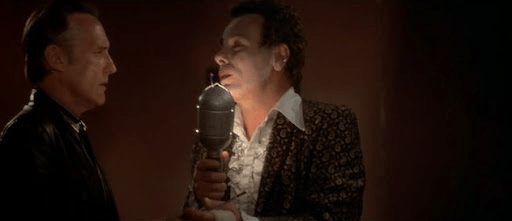
I was exposed to plenty of important cinema in this guy’s home theater but predatory atmosphere aside, they weren’t a good match for my earnest and frankly grave personality. The movies weren’t felt enough, weren’t taken seriously enough. There was a lot of laughing at Dennis Hopper’s psychopathy in Blue Velvet. Isabella Rossellini is beautiful, everyone agreed, but it never seemed like the ragtag movie night crew acknowledged we were also watching a movie about sexual abuse. They laughed at it and reveled in its weirdness, a preview perhaps of the phenomenon of audiences not knowing how to comport themselves at serious movies anymore. This group is far from the only sample who should have been denied knowledge of rifftrax but they still had a remarkable inability to drop the bit. There’s not anything funny about the scene in which Dean Stockwell’s Ben, pallid as a porcelain harlequin, lipsyncs to Roy Orbison’s “In Dreams,” at least not in a lol so random way. It’s a gorgeous song cutting through a disturbing tableau. Kyle MacLaughlan’s Jeffrey, our innocent straight man plunged into the horror that Dorothy (Rossellini) is captive to, is confused and unbalanced as he watches Ben perform. But Hopper’s monstrous Frank Booth is agitated, visibly coming undone as he hovers just outside of the microphone’s glare. I like to think that Jeffrey is taken aback by the timeless beauty of the music in the midst of his growing nightmare. I like to think that Booth can’t stand the intrusion of such beauty into his little kingdom of evil.
(more…)
-
I wrote this a while ago.
There is a new Sally Rooney novel out. As with Beautiful World, Where Are You‘s rollout in 2021, Intermezzo comes on a wave of recycled discourse about the author: her spare writing style, her Marxism and how it is or isn’t present in her work, what her success Means For the Novel, what she has to do with “literary hot girls” (or “literary it girls”), and I guess somewhat related to that last one, how all of her characters are thin. I think the reason this is all so repetitive is because it never sticks. Whatever Rooney’s dominance in her field means, she keeps writing and people keep enjoying her books. She is, by all accounts, a very private person and aside from the occasional profile where she wears lovely sweaters, she doesn’t feed us much to keep any kind of it girl persona burning. She mostly saves her influence for dropping bangers of rare moral clarity. She seems to be pretty skinny under those sweaters I guess.
The people who criticize her novels for being populated with exclusively thin characters are correct in that…uh, they are. Conversations with Friend‘s Frances routinely describes herself as very thin, almost underdeveloped. She forgets to eat and/or runs out of money for food. Whether her restriction is accidental, circumstantial, or intentional is left murky. Normal People‘s Marianne, while it is never explicitly named, has some kind of eating disorder. Beautiful World‘s four protagonists are all slim and basically attractive, Eileen in particular. I just got Intermezzo in the mail, but I hear it has the same pattern going on. Maybe Rooney herself has had disordered eating at some point. She’ll probably never say so, and that’s fine! In Frances I recognized my own experience in college – during part of which I was very anorexic – of forgoing food and feeling my mind race, like I could tackle or study anything for hours. I used to intellectualize my hunger as the desire to only contain one “pure experience” inside me at a time, as if the words I read while starving were truer forms of themselves. In Marianne I recognize being an outsider (both by choice and not), struggling to separate love from violence, and the compulsion to seek things that mirror my own self-hatred. If these characterizations are also shades of Rooney’s own life, is it wrong to put them in her books? The argument is that she seems to exclusively write about thin characters. To that I suppose I can say, you’re right, but it seems weird to single her out when there are many, many other authors doing the same thing and doing it in more explicitly fatphobic ways.
A common criticism is that eating disorders, financial difficulties, etc. aside Rooney equates thinness with beauty. I’m not sure that’s actually true. Frances makes a crack about being thin enough to look interesting, which strikes me as more of a self-deprecating observation about equating thinness with beauty, not endorsing it. Frances does not seem to find herself or her body beautiful. Marianne’s “ugliness” is hard to pin down. She’s too spiky and weird to be acknowledged as attractive at her rural high school and blossoms in college, so there might be a little bit of “young woman’s literature protagonist described as ugly actually hottest girl in the room” going on, but again, she never finds herself attractive. Her physical frailty is not why Connell, the person who loves her, finds her beautiful. Rooney’s characters struggle with restrictions and constrictions that lead to their feeling disembodied. Their thinness is often a signifier of a lack of joy and their beauty is recognized and drawn out by connecting with others.
I am actually less interested in disordered eating in Rooney’s world than I am in how eating – or not eating – reflects the emphasis in all of her novels on interpersonal connection and love being a redemptive and generative force. The skinny girls of these books differ from my own experience in one major way, and that is that they are not preoccupied by food. They forget to eat, they are utilitarian about it when they must, or their loneliness and suppressed lives seem to extend to all of their habits. When her characters are lost in their heads, alone, or struggling, they undereat or resign themselves to depressing, flavorless meals. When food does appear in abundance, it’s at the rare family meal, or more often, a dinner party with friends. When the four friends of Beautiful World are finally in the same physical space towards the end of the novel, they put care and joy into making a special dinner. This makes it into the TV adaptations of Rooney’s work, too. In Normal People, Daisy Edgar Jones’s Marianne enjoys eating in situations where she is welcomed and unburdened: having ice cream with Connell in Italy, having a birthday cake with the friends who turned out to be worth keeping, or eating holiday dinner at Connell’s mom’s house. In the adaptation of Conversations with Friends, the dinner thrown by the vivacious Melissa on the Croatian holiday Frances joins seems like something out of an Alison Roman cookbook: whole crispy fish surrounded by lemons, food that looks thrown together but homey and abundant.
This is just a sort of messy thing that’s been rattling around in my brain for years. I think the way food and restriction function in Rooney’s novels is meant to say that eating, like many of life’s necessities, is made better or perhaps even only a joyful action when it is shared. When her characters let themselves cook or eat with lightness and even relish, they are opening themselves to friendship or romance. The fair rebuttal to all this is that the bodies of the characters and their relationship with food aren’t the same thing. A character who isn’t thin could have the same experience of only really enjoying food when it’s made with hospitality or love. Sure. But is it really such a big deal?
-
Media hors d’oeuvres

just think of me as carrie bradshaw with a PC I don’t think I’ve completed a blog post, much less any sort of structured writing, since having a baby in March. Yikes. I thought it might be a nice way to use my atrophied muscles to just write some impressions of things I’ve been watching, reading, doing, etc. instead of thinking that everything must be a fully realized essay. It’s been a struggle in general to stick with a writing practice since graduating from my MFA, something I’m not proud of. As a writer or “writer” it’s easy to shoot myself in the foot. Some interesting idea will come up with my parents, or I’ll watch a great movie with a friend, and someone will say “oh you should write about this!” I can feel irritated or borderline resentful of that mostly imagined pressure. My mind fills up with the weight of unwritten pieces instead of just, you know, doing something. So here’s a bit about what I’ve been into lately.
Watching
It’s all about love in the end
A Murder at the End of the World
With its Christiesque title, copy about “gen z Sherlocke Holmes,” and promo image of Clive Owen as a menacing? tech billionaire, I marked A Murder at the End of the World as something to watch by myself, like those schlocky Harlan Coben thrillers on Netflix or adaptations of things with Girl in the title. But about half an hour in, I knew I had to start over with Paul. Emma Corrin plays Darby Hart, a young hacker and amateur detective of sorts. I haven’t watched something with Corrin since they were a mesmerizing young Diana on season 4 of The Crown. As Darby, they are rangier, twitchier, and more street smart, but I’m reminded of their canniness at embodying characters who can’t relax, whose small movements betray anything from insecurity to paranoia. In the first scene of the show, Darby shows up at a bookstore to read from her debut true crime memoir, Silver Doe, detailing her experience tracking a serial killer when she was just a teenager. She arrives insulated by a hoodie, music pounding in her ears: comforts she’s reluctant to drop even in front of an audience. Darby is not charismastic per se, but what motivates her book and a lot of her whole deal – that the lives of the forgotten dead are worth justice and attention – captivates the crowd and we can see her ease into her own expertise. This sets the tone for her character going forward: often the smartest person in the room, and a weirdo who is hard to ignore even if she might prefer to be.

Emma Corrin as Darby in her hacker lair An invitation to an exclusive Icelandic retreat run by Andy “King of Tech” Ronson (Owen) thrusts Darby into rooms full of other people used to being the smartest, including her first love and partner on her bygone vigilante roadtrip, Bill. Harris Dickinson is perfectly cast as an indie sleaze revival heartthrob with a soulful demeanor. Other guests include Joan Chen as Lu Mei, an architect of smart cities, and Alice Braga as Sian, an astronaut with gentle swagger. Ronson’s wife, Lee (the show’s creator Brit Marling), also happens to be the reclusive hacker Darby has idolized since adolescence. The framing is very 2023 And Then There Were None. It’s not long before the titular murder, and indeed more bodies drop in subsequent episodes. Part of what I wanted Paul around for is to give insight on what science and tech details are smart and which are just sort of throwing buzzy topics at the wall.
(more…)
 feelings.technology