

I don’t think I’ve completed a blog post, much less any sort of structured writing, since having a baby in March. Yikes. I thought it might be a nice way to use my atrophied muscles to just write some impressions of things I’ve been watching, reading, doing, etc. instead of thinking that everything must be a fully realized essay. It’s been a struggle in general to stick with a writing practice since graduating from my MFA, something I’m not proud of. As a writer or “writer” it’s easy to shoot myself in the foot. Some interesting idea will come up with my parents, or I’ll watch a great movie with a friend, and someone will say “oh you should write about this!” I can feel irritated or borderline resentful of that mostly imagined pressure. My mind fills up with the weight of unwritten pieces instead of just, you know, doing something. So here’s a bit about what I’ve been into lately.
Watching
It’s all about love in the end
A Murder at the End of the World
With its Christiesque title, copy about “gen z Sherlocke Holmes,” and promo image of Clive Owen as a menacing? tech billionaire, I marked A Murder at the End of the World as something to watch by myself, like those schlocky Harlan Coben thrillers on Netflix or adaptations of things with Girl in the title. But about half an hour in, I knew I had to start over with Paul. Emma Corrin plays Darby Hart, a young hacker and amateur detective of sorts. I haven’t watched something with Corrin since they were a mesmerizing young Diana on season 4 of The Crown. As Darby, they are rangier, twitchier, and more street smart, but I’m reminded of their canniness at embodying characters who can’t relax, whose small movements betray anything from insecurity to paranoia. In the first scene of the show, Darby shows up at a bookstore to read from her debut true crime memoir, Silver Doe, detailing her experience tracking a serial killer when she was just a teenager. She arrives insulated by a hoodie, music pounding in her ears: comforts she’s reluctant to drop even in front of an audience. Darby is not charismastic per se, but what motivates her book and a lot of her whole deal – that the lives of the forgotten dead are worth justice and attention – captivates the crowd and we can see her ease into her own expertise. This sets the tone for her character going forward: often the smartest person in the room, and a weirdo who is hard to ignore even if she might prefer to be.

An invitation to an exclusive Icelandic retreat run by Andy “King of Tech” Ronson (Owen) thrusts Darby into rooms full of other people used to being the smartest, including her first love and partner on her bygone vigilante roadtrip, Bill. Harris Dickinson is perfectly cast as an indie sleaze revival heartthrob with a soulful demeanor. Other guests include Joan Chen as Lu Mei, an architect of smart cities, and Alice Braga as Sian, an astronaut with gentle swagger. Ronson’s wife, Lee (the show’s creator Brit Marling), also happens to be the reclusive hacker Darby has idolized since adolescence. The framing is very 2023 And Then There Were None. It’s not long before the titular murder, and indeed more bodies drop in subsequent episodes. Part of what I wanted Paul around for is to give insight on what science and tech details are smart and which are just sort of throwing buzzy topics at the wall.
Murder wants to deal in big topics, from AI to robotic automation to the climate crisis, but it succeeds most on a quieter level. I’m endeared by Darby’s self conscious use of old tech, like her original iPod and those cool speakers. I like the flashbacks of her growing relationship with Bill, sharing what hacking means to them over late night video calls, dim Midwestern rooms fuzzy in the background. Their roadtrip chasing a serial killer takes them through the diners and motels of the parched West. The landscape they drive through in Bill’s borrowed El Camino is probably Utah but it looks enough like my former homer of New Mexico to make me wistful. There’s a lived-in feeling to Darby and Bill’s relationship to tech. They seem like characters out of time, nostalgic for an era of computing they themselves did not live through. They are both soft spoken but stubborn, intense characters, and the chemistry between them crackles. Their relationship, to me, is the best thing about the show, and mostly why I enjoy watching it with my husband. I’m not sure how well it’s setting up the pieces as a murder mystery, but as a subtle and touching love story it’s succeeding. An episode that involves an army of robots scuttling across an isolated, snowy expanse closes out with a flashback to the first time Darby and Bill met in person. We watch Darby nervously elbow her way through a crowded restaurant, uncertainty giving way to the unmistakeable warmth of romance when she finds Bill. Even in stories about the speculative and near or far fetched tech future, it’s the timelessness of vulnerability and connection that always gets me.
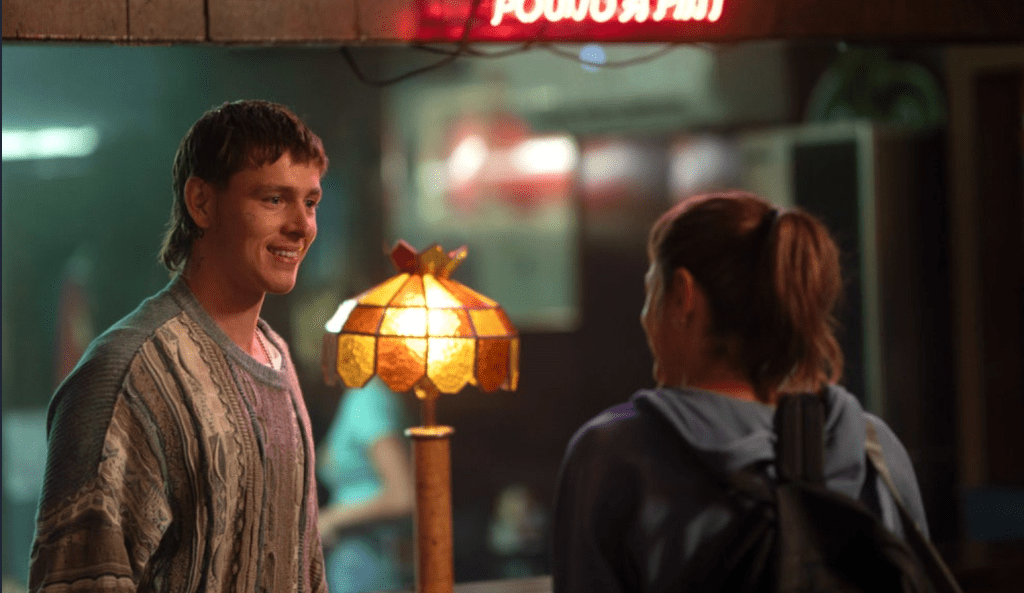
Of the things I’m keeping up with that are currently airing, Murder is the show I feel most excited to watch when a new episode comes out. For reference, that means it’s beating For All Mankind (often very good) and The Buccaneers (very stupid). Special shoutout to Edoardo Ballerini and the old world butler gravitas he brings to his performance as Ray, Ronson’s AI assistant.
The Golden Bachelor + Bachelor in Paradise
About 4 years ago one of my most singular, weird, and wonderful writer friends got me into The Bachelor. There’s not a good reason why I wasn’t already part of Bachelor Nation. The reality TV juggernaut premiered when I was in 6th grade, making me the right age to have started and forgotten to stop. Yes, like most Bachelor recappers of note, I’m of a cultural and intellectual millieu that I guess is supposed to be too good for it or at least enjoy it with cynicism. But as someone I used to know once said, if you wear a cowboy hat ironically, you’re just another guy in a cowboy hat. I enjoy The Bachelor, the end!
This fall, we have been graced with two iterations of the franchise and it’s interesting to me that they represent the opposite poles of what kinds of stories The Bachelor is trying tell. Or maybe it’s more accurate to say what kind of currency the franchise trades in for these particular love stories. Bachelor in Paradise, the rowdy cousin of the main Bachelor/ettes, is the one where contestants from past seasons are, to paraphrase Edith Wharton, somewhat awfully…assembled…on the beach of the Playa Escondida resort in Mexico. Instead of one lead choosing between dozens of hot people to date, the game is to get into a serious relationship or at least “form a connection” by every rose ceremoney. Men and women trade off who gives out the roses, so Paradise is a sort of “girl math,” sometimes. Near the end of the show, the couples decide whether to seriously consider getting engaged. Plenty have, but the format is looser than the flagship shows so you also have a lot of people leaving the beach with vague intentions to continue dating, or having awkward conversations about how they “don’t think they can get there.” Sorry for all the quotes. Some are my sarcasm and some are because Bachelor English is its own dialect. I like Paradise’s chaotic nature. I like how the beach seems like limbo. The Vulture recapper wrote recently that the beach might be purgatory but I need to state that I have made that observation. (I highly recommend the Vulture recaps and I’m sad that The Ringer doens’t seem to be doing written recaps anymore.)
Paradise is very produced and manipulated, just like its more illustrious relative, but the setup has a lot of built in flexibility. Yes, the cast is surely picked by whoever is the Paul Oberstein of Bachelor HQ to maximize drama, love triangles, and sponcon deals. But unlike the main show, where contestants are chosen in hopes they’ll mesh with one lead who has the power to send them home, once the singles are unleashed on the beach, there is more potential for genuine chemistry. And this is why, traditionally, Paradise has been my favorite. It’s stupider and hornier, and in those two very human things, is occasionally the most real. There are still gestures to sex only happening in serious relationships but you can also do it whenever! The past few years, including the current season, Paradise has let me down because nobody is having sex. There’s a halfhearted pantomime of horniness but mostly people lie around on daybeds, enwtined more like sleeping kittens than lovers. Unavoidable realities of the Bachelor Nation Stable of Talent existing in the wild, like former contestants hooking up or at least Instagram dm’ing in the real world, have now entered the text of Paradise. People come to the beach and explicitly talk about who they’d like to see…and what do you know, that person is almost always there! Chemistry can often bloom in the unexpected, when two people are wrongfooted in the best way by the mystery of the other. Unfortunately Paradise is becoming the show where the mystery is dead on arrival.

If Paradise was supposed to be The Bachelor‘s crazy fanservice beach episode, The Golden Bachelor wanted to recapture the original’s legitimacy as a love story. This time, the bachelor was a mild-mannered, 72-year-old widower named Gerry Turner. The Indiana native married his high school sweetheart and by all accounts had a wonderful marriage, before losing his wife suddenly in 2017. The Golden Bachelor pushed a narrative of “finding a second love of his life,” a sentiment that acknolwedged the irreplaceable connection Turner had and the life he lived. That’s already more realistic and somber than The Bachelor/ette‘s idea of finding one’s “person” young and in a whirlwind televised romance. Many of Gerry’s contestants, women between the ages of 60-75, were also widows. Watching adults who have lived, loved, and lost was refreshing. In recent years dates on The Bachelor/ette have taken on a formula of fun activity + sit down dinner + sharing the worst thing that’s ever happened to you. At some point the contestants seemed to start doing this unprompted. Many of these stories have been genuinely upsetting and/or moving, like Brooklyn on Zach’s season of the Bachelor sharing her experience with domestic violence. But you can tell sometimes a guy or gal is reaching to seem damaged. A more expert Bachelor fan than I am could probably pinpoint the exact moment this became the done thing. Was it Pilot Pete’s equating drama and sadness with depth of feeling, Clare dragging everyone into the therapy speak future, or something else?
Anyway, Gerry ended up proposing to Theresa, the woman with the story and numerical age closest to his own. There was some grumbling about how the other two women in his top three, Faith and Leslie, were among the youngest and “sexiest” but come on, they are all over 60, we don’t need to do age gap discourse. Yet The Golden Bachelor didn’t end feeling like a triumphant story of two people finding their last great love. Part (most?) of this is on the show. Real life was always going to catch up to the image of Gerry as the perfect, most respectful, aw shucks good guy. Before the finale aired, a story about how Gerry might not have been honest about his career or as upstanding in romance as he portrayed himself was published. I don’t know how much I care. People can be good partners even after having been awful ones in the past. I do wonder if the producers knew this and covered it up or were as surprised as we were. You think this team would have watertight background check skills at this point, yet secret girlfriends and racist instagram posts are always turning up!
I’m not the first to point this out, but my takeaway from The Golden Bachelor is that you can’t make it…not The Bachelor. Gerry was criticized for the way he broke up with his runner up, Leslie, after telling her he loved her and alluding strongly to plans for their future. It’s always the leads who fret the most about not wanting to hurt anyone that end up doing just that, and badly. No matter your age, no matter your life experience and wisdom, you are still a guy on TV systematically narrowing down women to find your soulmate. Yes, I will absolutely watch The Golden Bachelorette if and when that happens.
Pantheon

Of everything I’ve watched lately, Pantheon has given me the most to dwell on. Actually I dwell on what And Just Like That… has done to Carrie and Big, one of the all time couples, daily, but that’s for its own post. The animated series based on the short stories of Ken Liu premiered in 2022 on AMC+, was stuck in streaming no man’s land for a while, and ended up on Prime for its second and final season. Pantheon, like apparently everything, is about love and grief.
The heart of Pantheon is Maddie Kim, a withdrawn, bullied teenager struggling in the wake of her beloved father David’s death a few years prior. She gets help from an online stranger and soon realizes the communication quirks of this anonymous savior remind her of her dad – because it is. Before David died, he volunteered to undergo an experimental surgery to scan his brain and upload it to the cloud. The Kims were told the procedure failed. David’s employer, Logorhythms, lied. David did indeed become an “uploaded intelligence,” or UI, but until recently was being exloited for labor, disconnected from his emotional mind and memories of his family. This discovery opens the door to a horrifying, wide-reaching conspiracy involving Logorhythms and other corporations, but it also gives Maddie the thing she most wanted: to talk to her dad again.
I’m feeling exhausted by the idea of conveying how many Big Concepts Pantheon covers, worried that I won’t convincingly write about how it’s good sci fi, not wanting to bog myself down in recapping. I think the important thing about the show is that even if the stakes and scope of the story become basically as big as can be, it’s about people who want normal things. They want these things so badly they’re willing to go to extraordinary lengths. Maddie’s reunion with her father leads to the Kims meeting another man who has discovered his deceased wife is an exploited UI. He, like Maddie, just wants to be with his loved one again. The center of Logorhythms is Stephen Holstrom, a what-if-Steve-Jobs-wanted-to-be-god figure. He is dead before the story begins, but others are carrying out his dream of uploading most if not all of humanity. He’s the only major character who wants something weird. Critically, he relies on people wanting normal things to achieve his goals, most notably the woman who loved him in life and will still do anything for him.

Opposite Maddie is Caspian, a sexy-morose young man who has not had the kind of grounding family life the Kims have. He seems to struggle to want anything, unmoored from a sense of idenitity and purpose. His existence is bound up in the issues of UIs and Holstrom’s plans, but it isn’t until he meets Maddie that he feels empowered to be an actor in his life, to want things, or even just to feel a little lightness or hope. On their journey together they meet others, both “embodied” and uploaded, who have struggled to be understood or loved or known. The way they cope with this is sometimes fantastical, but it’s all very human. Two people may be speaking to each other as MMO-inspired avatars, but they’re discussing how to understand their marriage after one has already grieved the other’s death. A UI character contacts her bereft husband by hacking phones and sound systems to play When in Rome’s “The Promise,” showing that even with advanced future technology, posting lyrics is eternal. Pantheon is interested in pushing the questions of wanting normal things to their limits – what would you do if you could continue to love someone but not touch them? How far would you go to get a few more minutes with someone?
Years ago, before we were a couple, my husband lent me his DVDs of the anime Planetes. The hard sci fi about a ragtag crew of space debris collectors had come highly recommended by various outlets and people, but Paul was the only person to actually sell me on it. Before, I had seen it praised for its scientific accuracy. Paul said it was about human connection. Sometimes I’ve wondered if I’m just a little stupid when it comes to science fiction, but “scientific accuracy” is such a boring, dork-ass way to tell me a TV show is good. Planetes is wonderful by the way. All this is to say that if and when I recommend Pantheon to someone, I will tell them it’s about the questions and repercussions that arise around the issue of uploaded consciousness: digital owenership, embodiedness, and immortality. That it’s a smart show that takes impressively big risks. And that it’s about love.
Listening to
Vampire Weekend
There are artists who I feel I grew with, namely Lana del Rey. I have many embarrassingly sincere feelings about Lana’s growth over the past decade and change – and how lonely, self destructive and cinematizing her own abject womanhood Lana was there for me when I was doing similar things; how a more settled, contemplative Lana is lighting the way to normalcy (complimentary). Vampire Weekend is different. I can see their maturation and evolution and I can mark where I was and what I was thinking about when I listened to each album, but there’s not that sense of a mirror. I have never felt like Ezra and the boys were my peers. Their self-titled debut and Contra – can you see the tilted chandelier and preppy blonde alpha girl in your head? – came out when I was in late high school/early college. They’re bound in my mind with my devotion to Gossip Girl, despite not being used in the show. It’s all New York, but the New York of yearly visits and daydreams. It’s all Columbia. It’s all a world I was gravely convinced I belonged in even though I was just a troubled, as my high school boyfriend termed it, “anywhere but here girl” in South Carolina.

I didn’t listen to Modern Vampires of the City until some years after it came out. I was living in New York by then. My “oh fuck I’m really not a child anymore and the clay is hardening” reckoning started in earnest when I was 26. Modern Vampires, I think, is an album best appreciated by people who are going through or have already gone through that. If the first two albums created a sense of being the wryest insider at a party you still very much want to be at, this third showing is a little more cynical. They’re still at the party, but they’re wearier and frustrated that nobody else wants to have quieter, sadder conversations. Stale conversations deserve but a bread knife and all. This is the album I’ve been coming back to recently, and if pressed, I suppose I would say it’s my favorite of the four. Father of the Bride is the most mature, has the clearest, idk, philosophical voice*, and is a masterpiece, but I have a special place in my heart for the way Modern Vampires of the City heads home in the dark of a winter evening, just starting to second guess the lives it sees through lit windows.
Also of note: the co-creator of A Murder at the End of the World, Zal Batmanglij, is the brother of Rostam Batmanglij, one of VW’s founding members.
*the voice who gave us Neo Yokio
Reading
I’m sad and embarrassed that I haven’t finished an actual book in over a month.
Perfume reviews on Fragrantica
The elusive nature of trying to describe scent turns even amateurish or dashed off writing into endearing little gems. Fragrance is difficult to put into words and reviewers have to bridge gaps between the perfumer’s often extra whimsical copy, their own memories and experiences, the literal details of what it smells like, and so much more. It exists at the edges of the describable and I think that actually makes it easy to get peek into everyone’s own charming and wild internal world.
“Ahegao,” by Tony Tulathimutte in The Paris Review, winter 2023
Run, don’t walk, to get the latest Paris Review or get around the paywall or use someone else’s login info because our generation’s great bard of the mille feuille of shame is back and better than ever.
 feelings.technology
