
The week of January 13th was bad. Bad for me personally and bad for the world at large. It started out with the revelation of just how monstrous a guy whose work I never liked anyway really was. The next day I learned from the local newspaper that the man who abused me and multiple other men who hurt me as a young woman were going into business together. The next day, David Lynch died. The midweek headliners – the non celebrities of this news cycle, the big fish in the small pond – are the types to post about Lynch on social media. It was, some 16 or so years ago, at one of these men’s homes, that I first watched Blue Velvet. Did that lead me to watching Twin Peaks or was I already in the middle of it? I can’t remember. I am as old or older than some of these men were then. For a few years I was the youngest member of a weeklyish get together. We would pregame while drifting around the host’s ornate first floor rooms. It was his house that got me. Tucked just around a corner in a historical neighborhood and covered with cream colored stone, it was big and old enough to be a closed floor plan and I moved through the library, the dining room, the parlor, marveling at his knick knacks and fine art prints. Like me, he hung prints of famous paintings in beautiful frames and gave them pride of place. The Birth of Venus took up a large part of the – I suppose he’d like it to be called a sitting room’s – wall. Böcklin’s Isle of the Dead (the painting that gets possessed in Neo Yokio!) was at the top of the spiral staircase to the second floor. I was especially fond of Cranach’s Judith in the library. I felt heady and dazed on these nights and I think I liked the wandering portion of the evening more than the entertainment. But eventually it was always time to go down to the basement, to the theater and the posters and the Victorian medical apparati on display. Heartbreak did not feel good in a place like that.
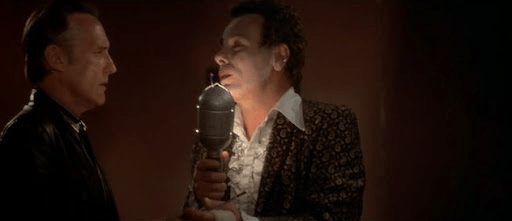
I was exposed to plenty of important cinema in this guy’s home theater but predatory atmosphere aside, they weren’t a good match for my earnest and frankly grave personality. The movies weren’t felt enough, weren’t taken seriously enough. There was a lot of laughing at Dennis Hopper’s psychopathy in Blue Velvet. Isabella Rossellini is beautiful, everyone agreed, but it never seemed like the ragtag movie night crew acknowledged we were also watching a movie about sexual abuse. They laughed at it and reveled in its weirdness, a preview perhaps of the phenomenon of audiences not knowing how to comport themselves at serious movies anymore. This group is far from the only sample who should have been denied knowledge of rifftrax but they still had a remarkable inability to drop the bit. There’s not anything funny about the scene in which Dean Stockwell’s Ben, pallid as a porcelain harlequin, lipsyncs to Roy Orbison’s “In Dreams,” at least not in a lol so random way. It’s a gorgeous song cutting through a disturbing tableau. Kyle MacLaughlan’s Jeffrey, our innocent straight man plunged into the horror that Dorothy (Rossellini) is captive to, is confused and unbalanced as he watches Ben perform. But Hopper’s monstrous Frank Booth is agitated, visibly coming undone as he hovers just outside of the microphone’s glare. I like to think that Jeffrey is taken aback by the timeless beauty of the music in the midst of his growing nightmare. I like to think that Booth can’t stand the intrusion of such beauty into his little kingdom of evil.
The first time I watched Twin Peaks, I immediately fixated on Audrey Horne. I already dressed like her sometimes, and to this day I need to exercise self-restraint to avoid buying yet another pleated tartan skirt. She was everything I was trying to embody at the time, or was I trying to embody the version of her that the men I knew saw? She was glamorous, a tease, and had that tantalizing quality of being corruptible but not corrupted. I got called jailbait a few times in those days. As Lynch’s passing has inspired my husband to finally watch Twin Peaks all the way through, I’m meeting Audrey again. “Do you get compared to her?” my husband asked when Audrey first appears in the pilot. I wasn’t sure how to answer that. The short answer is yes. The longer answer is my memories of how I became associated with Audrey have blurred. I can’t say with confidence if I saw her and wanted to be her, if a man or men remarked on some similarity that I then leaned into, or if those men were just amplifying my own, immediate sympathy and relation to her. And was the comparison superficial or were they actually, unconsciously, giving up their whole game? This time, around, I am mostly struck by how young she is. She is so young that she seems to me to move on a different plane than even the other high school characters. There is something of the shoujo protagonist about her. Audrey is not glamorous, actually. She is stylish and charming and has a novice’s inkling of how her beauty can be powerful, but she lacks the maturity and self-possession of glamour. Glamorous is: Norma, Josie, sometimes Shelly, or even Catherine Martell when she’s vamping it up. Yes, Audrey is gorgeous, and any grown man who denies that is suspect. But I condemn the grown man who sees a young woman trying to like black coffee because of a crush and sees nothing worth protecting.
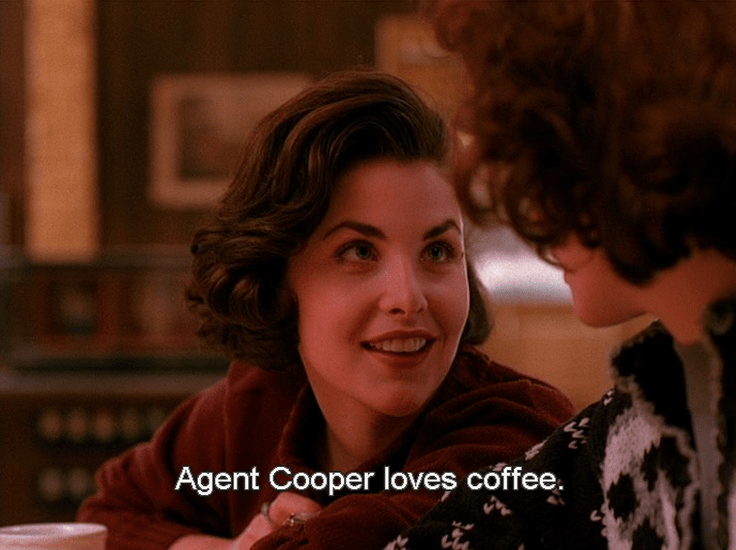
Dale Cooper has been described often enough as a “wholesome” character. I don’t like this word. But to be a pedant/pastor for a moment, a definition of it reads: “conducive to or promoting moral well-being.” To me, that sounds more complex, like something that should be applied more carefully than just slapping on anything that feels cozy and inoffensive. To promote moral well-being is a tall order! Instead, the understanding of wholesomeness that seems dominant now is one that is too naive and too unable to confront darkness – dare I say evil – to promote moral well-being. Wholesome ™ lets girls like Laura Palmer sink below the ice because it isn’t sharp enough to pierce the surface. Ignoring things doesn’t promote moral well-being, it just makes casualties of any moral well-being that can’t glide on wholesomeness’s frictionless tracks.
Cooper’s most aw shucks moments have become some of the most memed and rise to the top of basic Twin Peaks image searches, just as you have to scroll past a lot of Audrey’s sass and tying cherry stems in knots before you get a sense of the heart of the girl. This isn’t to say that Cooper’s innocent joys are any less sincere than his competence or commitment to justice. To me David Lynch’s visions of America are never just the wickedness lurking behind the pleasant facade. He, and Cooper, and I like the pleasant things wholeheartedly and earnestly. It’s not that simple joys are Trojan horses for evil. They are evil’s first casualties. For a joy to be allowed to exist as simple, it must be protected by engaging with the world unflinchingly. Something we see and hear mostly secondhand in Twin Peaks but experience directly in Fire Walk With Me is that Laura’s ability to have simple joy, to be a teenager in any normal way, has been taken from her.
Let me clarify here that I have not been through anything close to what Laura endured. Parts of my life have been sordid in a banal way. I have this dreadfully recursive orientation to an abusive relationship that ended almost 14 years ago, sometimes because the things that happened in it really do haunt me. If my mood dips into a depression or some other landmine is stepped on in my life I tend to have nightmares about my ex. One, hilariously, involved him telling me “you like to be hurt.” Not a lot of subtle imagery in my dreams. It’s the sympathetic pain from this relationship – and dealings with older men before and after it – that really eats at me. I became cynical too early because of it. One of the bedrocks of my worldview has long been that most people are cowards and will only act with what looks like integrity the moment being cowardly is no longer the most socially advantageous move. Some people tell me I’m wrong, but I sure would like to stop amassing evidence in defense of it if so! All this to say that I understand Laura’s gleefully nihilistic talk about how hard it is for anyone to be good, how easy it is to make men like her. I also feel like I didn’t get to be a teenager.
The Twin Peaks scene that changed my life is a pretty popular one. Cooper returns to his room at the Great Northern Hotel to find Audrey naked in his bed. Nothing happens, because he turns her down gently, telling her, “what you need right now, more than anything else, is a friend.” He tells her to get dressed while he goes to get some junk food. Most importantly, he promises to listen to her. I recognize Audrey so much in this scene because I also yearned to be seen and listened to. The details are always the same in these stories: I was told I was mature for my age, men took an interest in me with promises of respect for my intellect and how I saw the world. When it turned out that’s not really what they wanted, I started to see myself as just a body. At some point I became compulsive about the cycle, daring someone to turn me down. With time, like every version of me before me, I saw that these men were not desirable specimens of their demographic. If they were, they would not be up to this bullshit. Dale Cooper, however, is the finest humanity has to offer.
The bravado of Audrey’s “sexiness” is so fragile, her flirtations with Cooper so clumsy. When he meets her with utter sincerity instead of patronizing indulgence you can see the shock go through her. He is not the first person to be attracted to her, but he is the first person to take her seriously. When he tells her she has “a heart that yearns, be careful” he is being totally straight with her, expressing awe at her heart and courage and warning against so many forces that will take advantage of it. The men from my past might have said things like that – it’s easy to imagine them saying the exact same thing, actually. Little garnishes about seeing my mind or heart. Like Cooper, I’m sure these men saw how childish and awkward I was. When I was 17 a man told me “you have an unfinished beauty.” Well, why didn’t he go away and let me finish?

I have always cherished how in Cooper’s refusal of Audrey’s advances, he takes a moment to affirm her beauty and desirability, and desirability that owes itself to her personality as well as her appearance. Even as he protects the vestiges of her childishness, he doesn’t scold her like a child. He reasons with her as a woman, a friend, and a sort of emotional peer. Citing the standards he hold himself to as an FBI agent reaffirms why she loves him in the first place, too, because what draws her to him as much as anything is seeing a fellow person of integrity. In all my experiences with men who assured me that I was precocious and powerful, I was not actually treated as an intellectual or emotional equal.
I must return to Laura, because she is also a hero of protecting the innocent. I imagine, like the scene with Audrey and Cooper, that I’m in good company being moved by the Fire Walk With Me scene I’m about to mention. In it, Laura lets her best friend Donna follow her one night across the border to a seedy nightclub. Donna has begun to catch onto to the fact that Laura has an entire, wretched life she keeps secret. As a drugged out Laura is groped by a man – just a guy, any guy – she sees Donna. Alone and unprotected, Donna is surely about to get the same treatment Laura is subjected to so often she seems numb to it. Laura suddenly becomes feral, wrenching herself away and fighting towards Donna until she can pull her friend to safety. In this moment Laura would clearly kill to make sure her friend isn’t hurt. Cynical, fatalistic Laura doens’t let someone else slide into her point of view, even if it would mean having one person who could understand her. I have always hoped that if I’m ever in a position like the female friends of my old aggressors, I would never throw a girl to the wolves.

If Audrey is in so many ways who I was, by my young adulthood Laura is who I felt like. When David Lynch died, the outpouring of grief was immediate. For a while my whole timeline seemed to be united in appreciation and mourning. Many of these posts were from women who loved him because he loved Laura Palmer. The brutal experience of watching Fire Walk With Me, as relentless as it is, does not feel like a salacious lingering on Laura’s trauma, abuse, and death. It feels like Lynch showing us that he will never abandon this character or flinch away from the reality of her life. He dared to show a broken, haunted, well-into-the-territory of corrupted girl to be not only good, but a beacon of goodness itself. As it happened, I got to see Fire Walk With Me in a theater. I was alone on a Sunday in late summer. I remember being proud of myself because it was the day I realized that if my normal train wasn’t running, I had absorbed the subway enough into myself to know how to get where I needed. In the dark, in an arthouse theater that takes itself very seriously, I listened to people nervously chuckle, trying to find some of the charm and levity of the original Twin Peaks. It hit me how little time seemed to exist between that past me watching Blue Velvet and arriving at this moment in a different city, with a different David Lynch movie.
I started writing this post a few days after Lynch died and clearly it’s taken me a long time to do anything with it. When I write about these parts of my life, I usually get seized with disgust and want to scrap everything if I step away and think for a minute. I’ve also wanted to go exact vengeance on behalf of my younger self countless times while thinking through this. I also get bored of myself. How boring to be a woman writing about this! I wasn’t sure how to wrap it up, so hang with me here. One of the ways my grief about my past manifests is that I get really upset watching or reading things about sweet teenage romances or childhood friends etc. So, you know, anime. One of my favorite anime is Hyouka, from Kyoto Animation. Most KyoAni shows hurt but Hyouka hurts the most. It’s about a boy who falls in love with a girl so deeply he is catapulted out of teenage disaffectedness into real, colorful life. The girl is beautiful, accomplished, sweet, and carries the burden of her family’s local agricultural legacy. She is important to her family, to their small town, and to the boy who falls in love with her. My heart shreds itself thinking about how consequential and valuable this girl is, how reverently the boy looks at her. She is too dazzling to treat with anything but utmost care and respect. I adore this story but it always sends me into an absolute tailspin, weeping and gnashing my teeth over how I never felt a glimmer of that light touch. My husband and I talk about how if we had known each other in high school, maybe we could have been that couple. Instead, I feel like the glass inside me that should have guarded something precious is quarantining a nuclear wasteland.
“Laura is the one,” says the Log Lady in Twin Peaks: The Return. I don’t want to reveal too much for anyone who has the honor of going through the series for the first time. No matter Who Killed Laura Palmer or whether it ever feels like justice has been done (not really) there’s never a question that she was precious. Anything that conspired to treat her (or Audrey, Shelly, Teresa Banks, Dorothy Vallens) as less than that is a blight. I’ve spent most of my life thinking that I was too damaged, too early, to ever be someone truly valuable. I have felt – and still feel – like the rot of low worth rises off of me and that everyone can sense it. But Laura is the one. Her theme swelling up for the first time in The Return is incredibly moving. It feels like a moment of grace for all of us who love her. Her value has never diminished! I don’t know if Lynch sensed how many women felt something in them deeply held by seeing Laura cast as virtue in a great psychomachia. His is some of the only work that has made me feel like I can come through my own life and still perhaps be someone looked at and touched with awe.
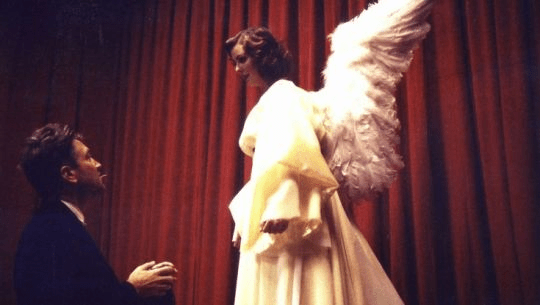
Lynch’s absence feels huge. I catch myself crying about it, still. Maybe it seems silly. I had no personal relationship with David Lynch, and his life was full in just about every way a life can be. Nevertheless it feels like something has shifted without him. It’s as if the balance of good and evil has been rocked a bit, and that would be appropriate, wouldn’t it? If anyone’s death could create the sensation of a void being opened, wouldn’t it be him? We’ve lost one of the warmest embraces and one of the sharpest knives.
 feelings.technology